Fish River Lakes Region February Ice Fishing Report: Big Eagle Togue, Scopan Splake, and Why the No-Snow Winter Built the Best Ice in Years
Tactical Takeaway: The cold, low-snow winter that frustrated snowmobile clubs delivered something rare: exceptional ice across the Fish River Lakes watershed heading into March. Big Eagle Lake is producing brook trout near four named tributary mouths and togue at 30–50 feet. Scopan Lake got a rare hatchery surplus stocking this year — more salmon and brook trout than usual. And if you can't find live bait, call ahead or bring worms. That's not a fallback. That's the play.
The Anglers Who Wrote Off This Winter Are Missing the Best Ice in Years
Spend enough time around ice anglers and you'll hear the same complaint every low-snow winter: no snow, no fishing. The logic runs that a snow-free landscape means cold nights with no insulation, hard freeze-thaw cycles, and unreliable ice. That's sometimes true. This winter, it isn't.
The cold temperatures that built up across northern Maine without significant snowpack did something valuable: they put down clear, solid, deep ice across the Fish River watershed early and kept it. There's no slush layer. No soft, rotten middle. The kind of ice that lets you drill a hole and actually see bottom on a shallow flat.
March is when most casual ice anglers start thinking about open water. That's exactly when the serious ones load the snowmobile and head north. Longer days. Manageable temperatures. Fish that have been living through a compressed, food-limited late winter and are ready to feed.
The Fish River Lakes region is worth the drive. Here's where to point the truck.
Why Is Big Eagle Lake One of the Best Backcountry Ice Fisheries in Maine?
Big Eagle Lake earns its reputation through simple math: 9,500 acres of protected water inside the Allagash Wilderness Waterway, accessed by logging roads from Ashland or Millinocket, with no direct road to the shoreline. The access points require a snowmobile ride. That snowmobile ride is a filter. Most anglers won't make it, which means the fish that do see pressure don't see much of it.
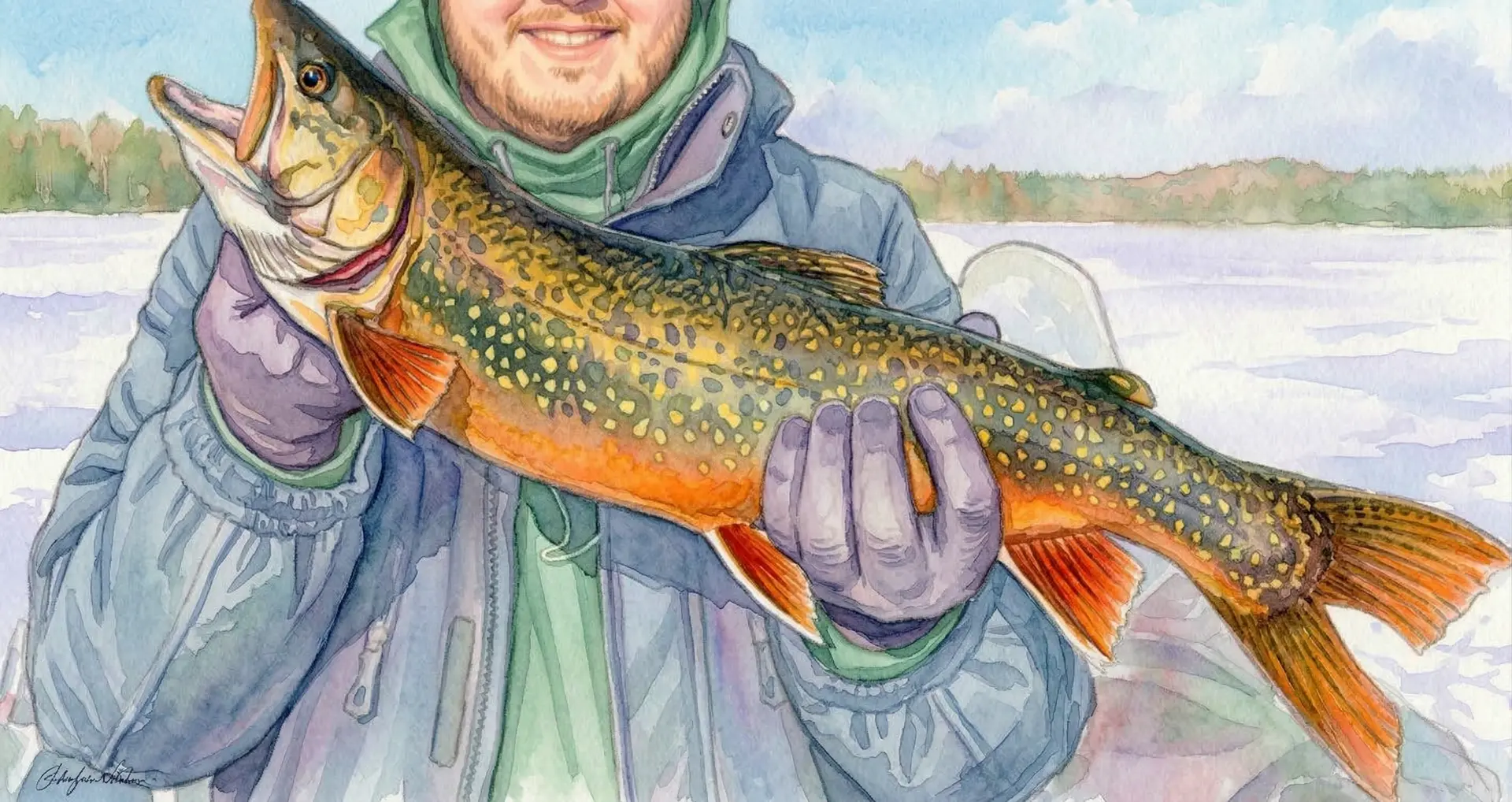
What you find at Big Eagle is a genuine wild fishery — Brook Trout (Salvelinus fontinalis) and Lake Trout (Salvelinus namaycush) — in a setting that hasn't changed much since the logging days.
Brook trout: fish the tributary mouths. Big Eagle has numerous tributary streams flowing into the main lake body, and late-winter brook trout concentrate near these inflows for a reason: tributary mouths are transition zones where slightly warmer, oxygenated water mixes with the colder lake. That mixing creates thermal edges. Baitfish — and the brook trout that eat them — stage on those edges.
The mouths worth targeting:
- Snare Brook
- Soper Brook
- Indian Stream
- Woodman Brook
Drill your holes 20–50 yards off the mouth rather than directly over it. The fish are using the transition zone, not the exact confluence. A small jig tipped with a waxworm or a live smelt suspended 2–4 feet off bottom is the standard late-winter brookie setup.
Lake trout: go deep and go live. Togue at Big Eagle are holding at 30–50 feet through late winter. Live bait fished at varying depths in that range is the most consistent method — tip-ups with live smelt set at different depths until you locate the feeding band. Don't assume they're all at the same depth. Stack your tip-ups across the 30–50 foot window and let the fish tell you where they are.
The drive is long. The snowmobile ride is cold. The fishing is worth it.
What's Biting at Scopan Lake in Masardis This Winter?
If Big Eagle is for anglers willing to burn a day getting there and back, Scopan Lake in Masardis is the alternative for anyone who wants a legitimate backcountry experience without leaving a forwarding address.
The species mix at Scopan is unusually broad for a single northern Maine water:
- Splake — a brook trout/lake trout hybrid (Salvelinus fontinalis × Salvelinus namaycush). Aggressive feeders, cooperative on tip-ups and jigs, and a species you won't find on most Maine waters
- Rainbow Smelt (Osmerus mordax) — the baitfish that makes everything else work, and a species worth targeting directly if the bite on other species slows
- Landlocked Salmon (Salmo salar sebago)
- Brook Trout (Salvelinus fontinalis)
The stocking note that most anglers don't know: Scopan received its standard annual splake allotment this year — and then received additional salmon and brook trout on top of that due to program adjustments and a hatchery surplus. More fish than a typical year. If you've been meaning to make the Scopan run, this winter is better than most.
Splake are a particular advantage for ice anglers: they combine the brook trout's willingness to hit a jig aggressively with enough size to make the fight count. They don't have the salmon's caution or the togue's passivity. When the splake are on at Scopan, the tip-up flags don't stop.
What Are the Best Family Ice Fishing Waters in Eastern Aroostook County?
Not every trip north needs to be an expedition. For anglers looking for an accessible, productive day on the ice — especially with younger fishermen in tow — eastern Aroostook County has several stocked reservoirs that deliver reliable brook trout action without the snowmobile or logging road logistics.
Durepo Lake and Trafton Lake in Limestone, and Monson Pond in Fort Fairfield are all now open to ice fishing and regularly stocked with Brook Trout (Salvelinus fontinalis). Short drives, manageable access, and fish that bite.
One important note on Durepo: Consult the fish consumption advisories in the current Maine fishing regulations rulebook before keeping fish from this water. The advisory exists and applies — know the specifics before you fill the cooler, especially when fishing with kids.
Trafton and Monson carry no such advisory. Brook trout, ice fishing basics, short trip home.
What Do You Do When the Bait Shop Is Out of Live Bait?
Here's the practical problem that hits every late-season ice fishing trip and that almost no fishing report addresses directly: bait shops in northern Maine run short on live baitfish in late February and March.
This isn't a supply chain mystery. It's simple logistics. Demand peaks late in the ice season, re-stocking is difficult in cold weather, and the shops that ordered for December can't always get more fast enough. If you're planning a trip and intending to fish live bait — particularly live smelt — call the bait shop before you leave. Confirm availability. Don't assume.
If they're out, or if you're fishing water where live bait restrictions apply, worms are not a compromise — they're a legitimate presentation, particularly for brook trout. A nightcrawler or garden worm on a small hook, fished just off bottom near a tributary mouth or along a gravelly or rocky bottom, pulls brook trout through the ice reliably and without the aeration equipment, transport hassle, or bait-shop dependency that live smelt require.
Brook trout don't know what month it is. They know what a worm smells like. Use that.
For more late-season tactics and presentation tips, see our Maine fishing tips and tactics.
Is the Ice Still Fishable in the Fish River Region in March?
The short answer: yes — and this winter in particular.
The low-snow, cold-temperature pattern that defined January and February in northern Maine built unusually solid, clear ice across the Fish River watershed. March will bring longer days, rising sun angles, and some moderation in temperature — but the ice is starting from a position of strength. Clear ice at depth holds longer and more predictably than the layered, slushy ice that builds in heavy-snow winters.
The standard cautions apply regardless of ice quality:
- Tributary mouths and stream inflows are the first areas to degrade as spring approaches. Current flow is constant and erosive. The brook trout are there — approach cautiously and check ice thickness before committing.
- South-facing shorelines and exposed points receive more solar radiation and thin faster than main lake ice.
- Check before every trip. March ice conditions can change in 48 hours. What was solid Monday may not be by Thursday.
The window is open. The ice is there. Go fishing.
Book a Guided Trip on Sebago Lake
When the ice goes out up north, it goes out on Sebago too — and what follows is one of the best landlocked salmon and lake trout windows of the year. We run guided trips on Sebago targeting both species, with years of local knowledge behind every decision.
Call (207) 321-9899 or visit SebagoLakeGuide.com to book your spring trip. The transition from hard water to open water on Sebago is fast and productive — and it books up quickly.
Browse our latest Maine fishing reports to stay current on conditions across the region.
Keep Reading
- arrow_forwardMaine fishing tips and tactics
- arrow_forwardLatest Maine fishing reports
Never miss a catch!
Explore fishing reports and practical tips from Sebago Lake and across Maine.